
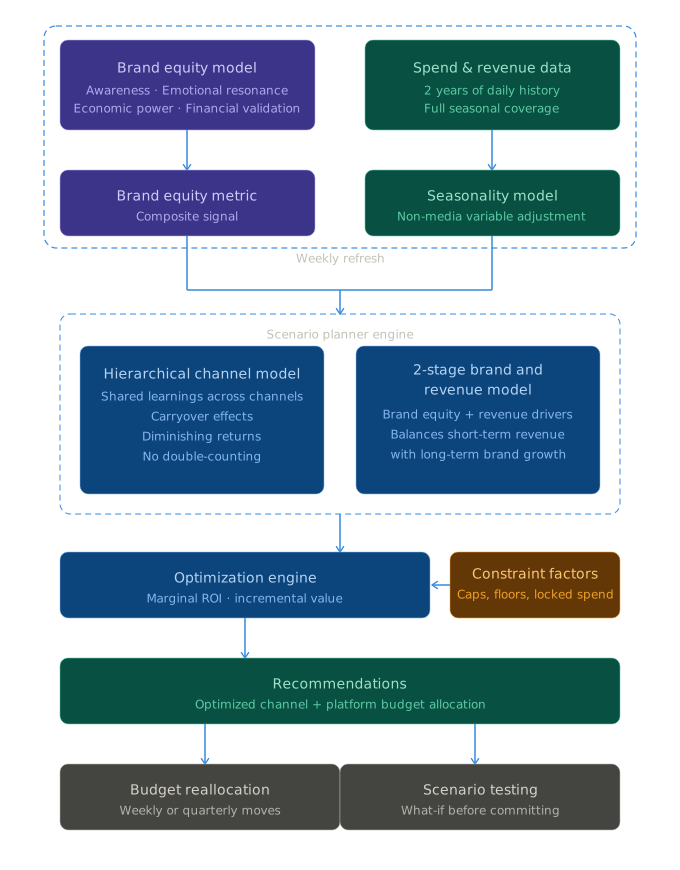
Scenario Planner in Alli answers one core question: where should the next dollar go to drive the most impact, without sacrificing long-term growth?
It does this through a structured pipeline that turns raw data into continuously updated budget recommendations.
Stage 1: Inputs — Performance + Brand,
The system starts with two inputs:
-
Brand Equity: A composite signal built from Brand Salience, emotional resonance, economic power, and Brand Durability.
This is not directional or qualitative. It’s a quantified input that the model uses alongside revenue. -
Performance Data: Two years of daily spend and revenue data.
This captures full seasonal cycles and prevents short-term spikes from distorting decisions.
Why this matters: Most systems optimize only for revenue. This ensures we’re balancing immediate performance with future demand.
Stage 2: Pre-Processing — Normalizing Before Modeling
Before modeling, both inputs are conditioned:
-
Brand signals are consolidated into a single, usable metric
-
External factors (seasonality, holidays, macro trends) are separated from media impact
Why this matters: The model focuses on what media actually drives, not what would have happened anyway.
Stage 3: Modeling — Capturing Real Incremental Impact
The core engine combines two approaches:
-
Hierarchical channel and platform modeling
Shares learnings across channels, accounts for carryover effects and diminishing returns. -
Two-stage modeling (Brand + Revenue)
Keeps long-term brand signals from being overridden by short-term revenue performance
Why this matters: Produces stable, realistic estimates of incremental impact across the full media mix.
Stage 4: Optimization — Turning Insight into Decisions
The optimization layer determines how to allocate budget by:
-
Evaluating marginal returns across channels
-
Applying real-world constraints (caps, floors, locked spend)
Constraints are applied here, not in the model, so they guide decisions without biasing the underlying math.
Why this matters: Outputs are actionable, not theoretical.
Output: Actionable, Continuously Updated Recommendations
The result is a recommended budget allocation across channels and platforms, refreshed weekly as new data comes in.
Teams use it to:
-
Reallocate budget with confidence
-
Test scenarios before committing spend
-
Build plans grounded in data, not intuition
Bottom Line
Scenario Planner in Alli connects brand and performance into a single decision system.
It continuously updates how budget should be allocated to:
-
Maximize short-term efficiency
-
Protect long-term growth
Result: Faster, clearer, and more defensible planning decisions.